I recently wrote an
article about one of my favorite contemporary novelists, Gene Wolfe, at the Speculative Faith blog. This spun out into one of my friends, Becky, saying that she
didn't think there should be a "must read" list of books, and then
DM Dutcher responding to that and
Becky responding to that, which brought me finally to writing this post. While I don't think there's such a thing as a "must read" list, there are certain authors who have changed the way I look at the world, showed me what's possible in fiction and inspired me to do better work. I thought it would be fun to share some of those, why they are important to me, and invite you to check out the ones that interest you.
These aren't in any specific order. Looking forward to your thoughts.
Gene Wolfe's Book of the New Sun (now packaged as Shadow and Claw and Sword and Citadel ).
). If you click on the first link in this post, you'll get a whole article about Wolfe. I read the Book of the New Sun and loved it. It's a beautiful science fantasy about a young torturer who grows up to (possibly?) be the savior of the world in the far future. Wolfe writes highly literate, complicated, baroque fiction with clear, profound Christian underpinnings. His work can be read over and over, and his short stories are often genius. I've read nearly everything the guy has written and here's the main thing I've learned from Wolfe: there's no such thing as a secular bias against Christian work, or if there is, it can be overcome and, in fact, smashed to bits by making compelling art.
John Steinbeck's East of Eden .
. My wife suggested I read this, and I completely balked. For one, it had a made-for-TV cover on it, and, secondly, I associated Steinbeck with Faulkner (who I do not enjoy). But this book is amazing. It's the multi-generational saga of two branches of one family... one representing Cain and the other Abel and wrestling with this question: Has God commanded us to overcome sin? Or assured us it can be done? Or told us that sin must win out in the end despite our attempts to the contrary. It's a book about being human, and it's beautiful. I re-read it every 20 months or so, and I enjoy it more each time. The main thing I learned from East of Eden: the story of humanity is compelling, and when explored honestly it sheds light not only on who we are, but who we could be.
Glen David Gold's Carter Beats the Devil
. I don't recall how I came across this book, but it's absolutely delightful. Part historical, part romance, part comedy, part tragedy, but all gorgeously written with a light, deft hand. The plot moves along, it's clearly written and it's emotionally evocative. It hits all the right notes, in other words, and reflects the human experience with humor and pathos while also being about a magician and his lady love and his pet lion. Gold taught me that a book could be light in tone and profound in meaning... that literature need not choose between high and low brow. And it just made me grin a lot throughout.
Kurt Vonnegut. I won't list just one of his books, as it's more Vonnegut's books as a whole that changed something in me. I read and enjoyed
Slaughterhouse-Five
(his most famous book), a humorous satire about the Allies killing innocent civilians in World War 2. Yeah, you read that right. But probably my favorite book of his is
Cat's Cradle
, a book that takes swipes at government, religion and war in a spectacularly hilarious way. It invents its own religion and has a nearly-nameless protagonist who finds love, religion and political influence mostly by blundering into them. Vonnegut taught me that satire can and should be funny, and that when your reader is laughing you can slip the knife in their gut and they don't really mind. This insight has come in handy in my own writing career when I wrote
My Imaginary Jesus
.
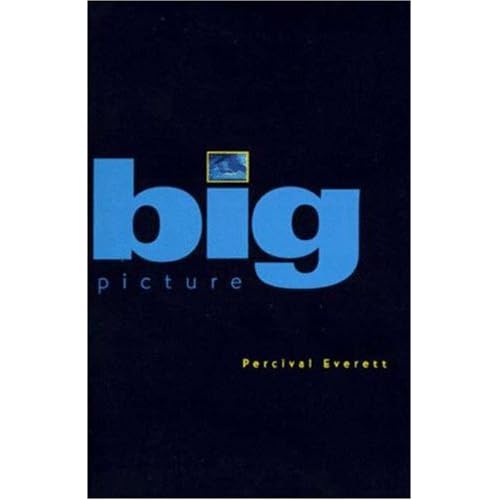
Percival Everett's Big Picture
. Percival Everett gets under my skin. Every book he writes I either love or hate. There's no middle ground. One of the ones I love is Big Picture. It's a collection of short stories that weave together in unexpected ways, that I'm not even sure were written to weave together and yet they do. It's haunting and draws a portrait of human beings that is rich, keenly observed and almost painful at times. If you read Big Picture and like it (I think you will), I'll give you the list of my favorite Everett books (of which there are plenty). Percival was one of my professors at UC Riverside once upon a time, and he taught me plenty in the classroom as well as on the page. One thing I've learned from his work: you don't have to go searching for comedy, there's plenty already out there in the midst of this messed up world. You just have to keep your eyes open and write what you see. Big Picture is, apparently, out of print, so you'll have to buy it used.
C.S. Lewis's Till We Have Faces .
. It's a requirement as a Bible believin' Eeeeeevanjelicul that I love C.S. Lews. And I do. I love him a lot. I first read the Narnia books when I was about seven and since then I've read everything the man has written, down to the fragments of novels and half-written short stories. When it comes to his fiction, I have three favorites. Till We Have Faces,
The Great Divorce 
and
Perelandra
. I still like the Narnia books (especially
The Last Battle
... and my own
Sword of Six Worlds
is unquestionably influenced by him), but Till We Have Faces is far and away my most beloved. Maybe because it's the only time that he adapted an actual myth (Psyche and Cupid), or maybe because it's the most intensely emotional fiction he wrote, but it's one I enjoy without reservation, and that shows God clearly, without ever talking about God. I learned in this book that it's okay (even admirable) for Christian books to wrestle with the hardest questions in the faith, to do it honestly and not to shy away from the most difficult conclusions and that then, like in life, those questions can lead the reader toward truth.
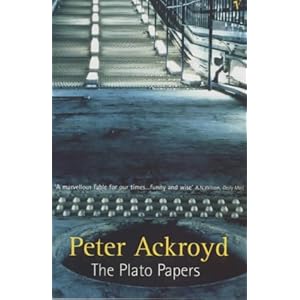
Peter Ackroyd's The Plato Papers .
. This strange, slight little book brings me immense pleasure. It's a satire of the 20th century's philosophies, science and historical methods, all set 17 centuries in our future, as our descendants try to make sense of the strange little world they uncover beneath modern London. The main character, Plato, holds lectures where he explains and lauds 20th century culture, with wonderful lectures that involve things like explaining how the ancient novelist and humorist Charles D had many interesting works, the most hilarious of which was "The Origin of the Species." It's also a retelling of the ancient Grecian Plato's life in some sense, which brings a complexity and feeling of familiarity to a very strange world. I've read this maybe ten times and it makes me laugh each time. This book taught me that strange doesn't mean inaccessible, and that sometimes an author can write about his deepest, most personal interests without thinking too much of his audience, and they will not only understand it, but enjoy it. Having that knowledge in the back of my head, of course, made it a little easier to feel that I could write
Night of the Living Dead Christian
and that, despite the zombies, werewolves and vampires, people could still enjoy the comedy and spiritual teachings in it.
G.K. Chesterton's The Napoleon of Notting Hill .
. Chesterton is another favorite who, in general, I like pretty much everything the man wrote. I came to him through C.S. Lewis, directly to The Man Who Was Thursday. The Father Brown mysteries are particular favorites, but when I read The Napoleon of Notting Hill I saw something amazing. It starts as a slapstick comedy set in a not-too-distant future where the King of England is chosen by a lottery system and it just happens to fall to a man who is more jester than king. He takes it upon himself to make fun of everyone by creating an invented history, complete with costumes and theme songs and flags, for every neighborhood in London, and much of the humor of the novel comes from the wacky things he does in this process. Then, suddenly, halfway through the book, a shift takes place and the book moves into a deadly serious, almost Shakespearean war book. One of the characters who has been seen, mostly, as the butt of the King's jokes becomes the hero of the novel, and what seemed like a slight diversion of a slightly satirical novel becomes a serious reflection on war and remembrance and what makes things holy. It's an amazing feat, and surprisingly rare in modern literature. This marriage of comedy and tragedy taught me that the walls of genre and categorization are thinner than we think, and can be manipulated deftly to avoid the reader feeling cheated, and simultaneously providing an experience that couldn't be achieved in one genre alone.
Frederick Buechner's Son of Laughter. I haven't read all of Buechner's books yet, but I'm working my way through. Each book is a sumptuous meal, and should be enjoyed slowly, relishing each page. He's a marvelous writer, describes action subtly and can put pieces in place that look like set decorations but are actually accumulating to an emotional payoff later in the story, for the characters as well as the reader. Son of Laughter is a book about the Biblical Jacob, son of Isaac, and it tells the story of Jacob and, to a lesser extent, his father and grandfather in a powerful and almost cinematic way. There were moments when I would think, "This part isn't in the Bible" and would go look it up and it was. He brings things to life that powerfully... seemingly unimportant comments in scripture would turn out to be of central importance to the people living the tales. Buechner teaches me that it's okay to breathe life and detail into the Bible, because that life and detail are already there for the watchful eye to uncover, and a fictional account can be more compelling than a hundred commentaries if done well.

FLANNERY O'CONNOR FOREVER! The Complete Stories
is everything you need. It's not an exaggeration that
I Love Flannery. I tried to convince my wife to name our last child Flannery, which was quickly vetoed. Her novels are amazing. Her stories are inescapably brilliant. I honestly think that "A Good Man Is Hard to Find" is one of the best short stories in the English language. "Parker's Back" is, bar none, the best example of the mystical experience of Christ being rejected by the religious Christian that I've seen anywhere outside of real life. When I read Flannery's work I feel like an apprentice painter standing next to Michelangelo. She's unflinching in her portrayal of the real world, unreservedly Christian and a professional artist to the point of absolute perfection in her work. I don't know that I can list one thing I've learned from her without it being a disservice to how monumental she is, but I will give it a try. Flannery O'Connor taught me that the job of the Christian artist is to look at the world without flinching, and to present it as honestly as possible. She believes (and this is clear in her work) that even the most grotesque things in this world point us toward Christ.
Necessarily, in making a list like this, most books sprang to mind as I wrote. What about
Lord of the Flies!
Watership Down!
The Brothers Karamazov
(the greatest Christian novel of all time)! And yes, these are all great books, but I have to stop somewhere. And while the first two impacted me enormously, the books on this list did more so. And the Brothers Karamazov is still working on me... I'm not sure what the end result will be, it's still in process.
What do you think? Have you read any of these? What did you think? WHAT'S ON YOUR MUST READ LIST? I'd love to find some new books to explore at your recommendation.


 , there are some things you can do to get the word out to others, too! Do some fan art! Or you can post a review of the book on Amazon or Barnes and Noble or Good Reads. Buy a copy for a friend or school teacher, or just link to it from your blog or Facebook or Twitter.





 , one of those
kernels was the Ring of Power and a haunted sword.
, one of those
kernels was the Ring of Power and a haunted sword.


