Saturday, September 22, 2012

Tolkien Week: One Sword to Rule Them All

In honor of Tolkien week and the release of The Sword of Six Worlds I've been inviting some friends to guest post about J.R.R. Tolkien and his influence on their work. Today's post (our last!) comes from Steve Bein, whose novel Daughter of the Sword comes out October 6th. You'll enjoy his post, in which he talks about using inanimate objects as characters in fiction.


One Sword to Rule Them All?

Sometimes people ask writers and musicians and artists where they get their inspiration.  I’ve learned that if you’ve got a novel coming out soon, you hear that question a lot.  In a sense it’s impossible to answer.  Inspiration for what?  This character?  This conversation?  This scene?  The whole book?  Inspiration isn’t one thing; it’s a gestalt, and usually an unconscious one at that. 

That said, sometimes I can identify kernels of inspiration—not the inspiration for the book, mind you, but a moment or an idea, something that latched onto a hundred other things in the deep recesses of my subconscious to make the story start to crystallize.  In the case of Daughter of the Sword, one of those kernels was the Ring of Power and a haunted sword.

In 2003 I published my first story, “Beautiful Singer,” about a samurai who insists his katana isn’t possessed by a slain geisha.  (It turns out he’s sorely mistaken about that.)  The story was published a few months after the theatrical release of The Two Towers and a few months before the release of The Return of the King, and since it takes me a long time to turn a story idea into a story, that means I was thinking about it well before The Fellowship of the Ring hit theaters—which means some twenty-odd years after I’d first read The Lord of the Rings, one of my all-time favorite books as a kid and one that remains in my top ten list today.

Seeing the movies and re-reading the book (I now read it about once a year) got me thinking about how on earth Tolkien managed to make the One Ring such a compelling character.  The word “character” doesn’t usually stick to inanimate objects very well, but the ring has a will of its own.  It has desires, and it exerts its will, and other characters have to react to that.  We even have a strong sense of its personality.  So there you have it: it’s a character.

Then “Beautiful Singer” came out, and I did some public readings, and it struck me that Beautiful Singer (the eponymous haunted katana) is also a character.  She has a goal and she tries to bring it about, and other characters ignore that fact at their peril.  So I started thinking: how cool would it be to write a whole book where the swords were the characters that drove the plot forward?  Call it naïve audacity, but I thought I’d try to do with samurai and swords what Tolkien did with hobbits and rings.

Daughter of the Sword is the result of that.  Beautiful Singer already existed, and I knew she was going to be very easy to characterize as the evil sword.  As much as I love Tolkien’s idealism, I prefer to push beyond good-and-evil, black-and-white, cowboy movie ethics.  So there isn’t “the good guy sword” and “the bad guy sword” in this book; there are three swords, and any one of them can oppose any other, and all three exert their influence over the characters that wield them.  They’re Saruman-like, fickle, equally capable of defending and backstabbing. 

There are other comparisons to be made between The Lord of the Rings and Daughter of the Sword—Mariko certainly has a bit of Éowyn in her—but it’s the swords that are the real homage.  So in this Tolkien Week, thank you, dear departed master of fantasy, for proving it’s possible to cast objects as characters.  In this as in so many things, he redefined what’s possible in the genre.  The best the rest of us can do is to emulate.

Friday, September 21, 2012

Tolkien Week: Top Ten Hobbit Covers from around the world

As you know, in honor of Tolkien Week and in celebration of my new book, The Sword of Six Worlds, we're talking about all things Tolkien here at BHR. Today I thought it would be fun to take a look at my Top 10 Lord of the Rings covers from around the world.

NUMBER TEN. 

I like how Bilbo looks like a baby in this one, and he's fighting the creepy monster, whatever it is.

NUMBER NINE.


This cover gives me hope that my kids have what it takes to make professional book covers in some countries of the world.

NUMBER EIGHT. 

This is pretty much how I pictured Bilbo when I first read the Hobbit, though the pipe is rather longer than expected.

NUMBER SEVEN.


Weird things to like about this one: It appears to be saying that by far the most important thing in the book is the pipe smoking. Notice the return of the giant pipe, and also that the dragon in the background is about the size of a sparrow. Bilbo doesn't seem to mind the dragon, and why would he? He has a pipe, after all. Also, the moon has managed to get itself stuck in that tree. Notice how it overlaps the branches. 

NUMBER SIX.


We might as well stick with the pipe theme. Apparently, if you live in Europe, the Hobbit is mostly a story about a little hairy guy who really likes to smoke his pipe. In this cover, in addition to being called a "Gnomo," Bilbo gets to lay his head down on a mushroom. Are there lots of mushrooms because the Hobbit is a kids' book and we must use mushrooms to show how small he is? Or is it a reference to the pipe? You decide.

NUMBER FIVE.


I like this French edition, but not because of anything weird. I just enjoy the decorations around the edges, and the fact that it appears to actually have a scene from the book on the cover.

NUMBER FOUR.


I enjoy the comically unconcerned Bilbo on this cover. "Look, I found this diamond in a hole. Isn't that wonderful? Hmmm. What's that I hear above me? A snarling dragon? Ha ha ha ha. Wonderful!" Also, the art appears to be by Pauline Baynes, who did all the illustrations for the Narnia books that I read as a kid. Anyone know if that's actually her?

NUMBER THREE. 

I really enjoy the depiction of Smaug on this cover. He looks so happy, like he's about to fly down and take someone for a joy ride. I also like the tiny guy in the pink robe threatening him with an axe while all the others are running away (?).

NUMBER TWO.


I find the style of this cover absolutely charming. It shows a scene from the book that is pretty much constant: Gandalf sitting Bilbo down to give him a speech. The hats are awesome, and Bilbo's little checkered jacket makes me laugh. This is a winner.

NUMBER ONE. The best cover to "The Hobbit" ever.


Come on. Smaug as mutated butterfly lizard? Bilbo is dancing on his back as if it's a Broadway musical, complete with top hat. This cannot be beaten. I love it forever.

HOW ABOUT YOU? Which cover is your favorite? Or is there another that you prefer that's not listed here?


Thursday, September 20, 2012

Let the music play... Ben Folds Five meets Fraggle Rock

Fraggle Rock, to me, is mostly a reminder that I didn't have cable as a child. I loved the muppets and here was this whole television show full of them that I couldn't see. It wasn't available on VHS. There was no Internet. It was maddening.

The Ben Folds Five was a mysterious but beloved rock band who apparently wanted to prove that the piano is more important than the guitar.

And now, at long last, they are rightfully together:


How about you? Any memories of Ben Folds Five, Fraggle Rock or the Muppets you want to share?

Tolkien Week: Frodo's Journey


This week we've been having guest posts in honor of Tolkien Week and celebrating the release of The Sword of Six Worlds. Today's post comes from Matthew Johnson, whose short fiction has appeared in places like Asimov's Science Fiction, The Magazine of Fantasy & Science Fiction and Strange Horizons and has been translated into Russian, Czech and Danish. His first novel, Fall From Earth, is available from Bundoran Press and Irregular Verbs, a collection of his short stories, will be published in early 2014 by ChiZine Publications. His website is www.irregularverbs.ca.

Frodo's Journey

Is Frodo a hero? He's undoubtedly the protagonist of The Lord of the Rings, and he does a great many things that may be called heroic, but the question of whether he is a hero -- and, in particular, of whether his story follows the pattern of the Hero's Journey -- is a good deal more complex.

The Hero's Journey, of course, is the story-pattern identified by Joseph Campbell and described in many of his books, most notably The Hero With a Thousand Faces. Though his work became widely known within his field, it didn't reach far into public awareness until George Lucas used it as the structure for Star Wars; this led to tremendous interest in Campbell's work and, later, to the hero's journey pattern being taken nearly as holy writ among screenwriters.

Campbell's aim was to identify the common patterns that are found in hero myths worldwide, in part to show that similarities between myths found in different places were due not to diffusion (the spreading of stories from place to place) but, in his opinion, due to the presence of particular archetypes within the human psyche. According to Campbell, King Arthur, Jesus and Gilgamesh don't have similar stories because the people who told stories about King Arthur had heard about Jesus and the people who told stories about Jesus had heard about Gilgamesh, but because all the stories we tell are psychological adaptations designed to help us through universal human experiences; in the case of the hero myth, the transitions between childhood, adolescence and adulthood.

That's why the basic outline of the Heroic Journey begins with a protagonist who, though seemingly normal, has a special or mysterious parentage and then receives a call to adventure that's often tied to those mysterious parents in some way. After trying to refuse the call once or twice the hero finally accepts it and is brought into a new world of wonders, where he makes allies -- often including a wise old mentor -- and typically acquires one or more magic tools that help him win his first victories over beasts and monsters. The hero must pass through an underworld or abyss to face Death, or someone or something closely symbolic of it (often a dark double of the hero), before emerging as a genuine hero. Once this has been accomplished the hero either returns home to take his place in society -- typically one of much greater importance or authority then if he had stayed home -- or else finds a new home in which he does the same.
(click to see a larger version)

What does this have to do with Tolkien? Certainly neither The Hobbit nor The Lord of the Rings could have been directly influenced by Campbell, since his first work on the heroic journey wasn't published until 1949. Still, considering the great influence of myth and folktales on Tolkien's writings (as well as the unconscious influence of his deep knowledge of these subjects) if there is any truth in Campbell's analysis then we should be able to find at least some aspects of the monomyth in Tolkien's work. And, as it happens, we can: many of his characters' stories have numerous elements of the Hero's Journey, and one of them follows it so closely it's almost hard to believe that Tolkien didn't know Campbell's work. I'm talking, of course, about Bilbo.

If you've read The Hobbit that description of the Hero's Journey probably sounded pretty familiar. Unusual only in his being descended (on his mother's side) from the formidable Took family, Bilbo is chosen by Gandalf to leave his comfortable home and go on an adventure. Of course he tries to turn the wizard down, but soon his "Tookish" side is awakened and he agrees to go. Early in his journeys he has to rely heavily on his mentor, but when they're separated (during a long journey underground) he acquires a magic ring and overcomes Gollum, a creature whose wet, slimy cave is a dark reversal of Bilbo's own comfortable hole. After he emerges from underground Bilbo is a much more formidable character, becoming the savior and de facto leader of the group in Gandalf's absence (especially with the aid of his magic ring) and, after being key to the defeat of Smaug he "dies" twice more: once when he is knocked unconscious during the Battle of the Five Armies and, in a more mundane but also more meaningful context, when he returns home to find that he has been declared dead and his relatives have moved into his house. Following his "resurrection" he takes his place as an important person in the community and the world, knowing that he has played a part in bringing ancient prophecies to life.

Though the connections between Bilbo's story and the Hero's Journey are striking, they're not really that surprising; Tolkien's theory about how different myths were connected, which he refers to as "the soup pot" in his essay On Fairy Stories, was very similar to Campbell's, though the two came to their conclusions from very different directions. In Tolkien's words, the Pot of Soup, or "the Cauldron of Story, has always been boiling, and to it have continually been added new bits, dainty and undainty." Both historical and fictional figures may, over time, be put into the Soup, where they mix with "many things older, more potent, more beautiful, comic, or terrible than they were in themselves." It's not surprising, then, that Tolkien's stories might be made up largely of ingredients taken from the Soup that once belonged to Theseus, Beowulf and so on. What is surprising is how poorly Frodo's journey fits the pattern.

To begin with, Frodo doesn't acquire his magic tools as he goes along, but has them from the beginning. He doesn't receive, or try to deny, a call to adventure: his journey is originally supposed to end at Rivendell. Like Bilbo he does undergo several underworld journeys, and when he encounters Gollum the creature is more explicitly a double (being identified in The Lord of the Rings as a hobbit who was warped by the Ring). Rather than triumph over him, however, Frodo is simultaneously betrayed and saved by Gollum. Most importantly, Frodo never truly returns home: like Bilbo he has been transformed by his experiences, but instead of being made into a solid member of society (symbolically, an adult) he "dropped quietly out of all the doings of the Shire." Nor does he return stronger than before, as the wounds he suffered on his journeys pain him until his final passage to the West.

It's not just the greater complexity or the darker tone of Lord of the Rings that keep Frodo from following the Hero's Journey: Merry and Pippin's stories fit the pattern nearly as well as Bilbo's does. For them the journey is truly an adventure, and their transformation is a positive one (they literally "grow up") as they become first heroes and then leaders back home. It seems likely, then, that Tolkien made a conscious choice to make Frodo's story not just not a standard hero narrative but almost a parody of one. Is if Frodo isn't a hero, then, what is he?

Take another look at the differences between Bilbo and Frodo's stories. Bilbo is undeniably the hero of his story, to the point where he sets in motion almost everything that happens in it: if he had stayed home the status quo would have remained almost entirely unchanged. Frodo, on the other hand, has no choice: war is coming, whether he wants it or not -- but when he does get to choose, his choice is motivated by duty, not adventure, and his experiences are largely mundane, made up more of slogging through mud than colorful adventures. That's not a hero's story, it's a soldier's.

As for why Tolkien chose to make The Lord of the Rings a soldier's story rather than a hero's, there are a number of possible answers. He may simply have been a more mature writer, or he may have been freed by the success of The Hobbit to choose a more unconventional narrative. As well, much of The Lord of the Rings was written while a war was going on -- a war in which one of Tolkien's sons was serving.

Tolkien had himself been a soldier in World War I, where he saw action at the Somme and was returned to England afterwards due to "shell shock" (what we would now call post-traumatic stress disorder), the symptoms of which are quite like Frodo's condition after returning to the Shire. Though Tolkien seems to have recovered more or less fully, he surely remembered the effect the war had had on him, and likely knew others for whom the effect was longer-lasting. It seems likely that when writing a much more serious and personal novel, one about a war that he saw, as he did the war he had served in, as "for all the evil of our own side with large view [one of] good against evil", he would have felt it dishonest to gloss over the pain and sacrifice he knew so well by casting it as a hero's story. 

Wednesday, September 19, 2012

The Hobbit movie trailer

Not that there was a lot of doubt that I would be going to this movie, but now I'm getting excited that it might be something fun and wonderful.

Tolkien Week: The Lord of the Rings and Gothic Fiction


This week, in honor of Tolkien Week and to celebrate the release of The Sword of Six Worlds, I have a variety of guests sharing their thoughts about J.R.R. Tolkien and his influence on their own work. Today's post comes from C.L. Holland, a British fantasy writer and poet. She has been published in Daily Science Fiction and several other places. You can visit her website, or follow her on Twitter.

“I wonder what sort of a tale we’ve fallen into?” - The Lord of the Rings and Gothic Fiction

When I agreed to write something for Tolkien week, I had the idea of revisiting my work on The Lord of the Rings and the Gothic. There’s a lot to be said on the subject, and about Gothic features in fantasy and science fiction as a whole Frankenstein is, after all, both a Gothic text and one of the earliest written examples of science fiction. LoTR, although it’s fantasy, shows some noticeably Gothic features.

One of the common tropes of the Gothic is for novels to be in the form of “real" documents. Dracula is a famous example of this, since it's made up entirely of journal entries, letters, and newspaper clippings. Frankenstein opens with letters, and the novel itself is presented as a journal with more letters within it. The same motif can also be seen in Melmoth the Wanderer and Dr. Jekyll and Mr. Hyde.

LoTR is also presented as being based on actual documents. As Tolkien notes in the Prologue, the novel’s predecessor The Hobbit is a selection from a (fictional) record called the Red Book of Westmarch. The Prologue goes on to discuss other “records” connected with Middle-earth (the world of the novel) and refers to LoTR as a history, an illusion furthered by the lengthy appendices in the back.

However, there is a difference between the use of “real” documents in the Gothic and in LoTR. In the Gothic these documents are often presented as collections of personal documents, letters and journals written by individuals about their experiences. LoTR, on the other hand, is not presented as a personal document at all.

The Gothic and fantasy often divide their characters into “good” and “evil”. In the Gothic such divisions are usually simplistic: Hyde is the evil to Jekyll’s good; Dracula is evil, the vampire hunters are good. This division is not always so overt, for example in the moral ambiguities of Frankenstein. LoTR follows the same general pattern of signposting good and evil: orcs, trolls, and Sauron are evil; whereas elves, hobbits, and Gandalf are good.

However in LoTR as in the Gothic, good characters can be tempted to evil. There are the obvious examples of Gollum and Saruman, who have been tempted even before the novel begins. Within the novel Boromir tries to take the Ring, and Galadriel, too, considers taking it when Frodo offers it to her. Frodo himself gives in to the lure of the Ring as he stands at the edge of Mount Doom. Ready to cast the Ring into the fire, he instead decides to keep it for himself.

Where LoTR differs from the Gothic is redemption. Boromir redeems himself by sacrificing his life trying to save Merry and Pippin from Saruman’s orcs, and Galadriel by refusing to take the Ring when it is offered. Frodo is redeemed by the actions of Gollum, who in trying to get the Ring falls into the fires of Mount Doom with it–an accident which arguably redeems them both. For the truly evil characters, there is no redemption. The same is true of Gothic villains: there is no redemption for Frankenstein, or Dracula.

A less obvious way in which LoTR resembles the Gothic is in its portrayal of vampirism. This doesn’t necessarily mean traditional blood-drinking, but the effect this particular brand of evil has on the characters. Dracula is one of the Gothic’s most famous monsters, and there are parallels with the novel in LoTR.

The critic Brian Rosebury wrote that the good in LoTR is diverse, whereas evil tends towards homogeneity–it negates all that is “not self”, through consumption, or through enslavement.* This consumption has obvious parallels with vampirism–the vampire, too, consumes all that is “not-self.” Shelob is not the only creature in LoTR that literally consumes others. Although Gollum was once likely “of hobbit-kind” he eats raw meat and fish, worms and beetles and is rumoured to eat hobbits, children, and carrion.

This negation of the not-self through consumption can been seen in Dracula in the figure of Renfield. He eats flies, but also collects spiders, to which he feeds the flies, and sparrows, to which he feeds the spiders. After being refused a cat, he eats the birds. Like Gollum he also evidences cannibalistic tendencies. In one of his saner moments he tells Mina how on one occasion he tried to kill his doctor “for the purpose of strengthening my vital powers by the assimilation with my own body of his life through the medium of his blood.”

Vampires, like Rosebury’s description of the evil in LoTR, are homogenous. Although they are nominally male and female, either sex can procreate and they do so in the same manner–by homogenising their victims into either corpses or other vampires. The One Ring also homogenises its victims. Gollum, Bilbo, and Isildur all call it “precious”, and it unnaturally extends the lives of its owners, while turning them into shadows of themselves. As Bilbo tells Gandalf, “I feel all thin, sort of stretched, if you know what I mean: like butter that has been scraped over too much bread”.

LoTR is far from the only fantasy story showing features of Gothic fiction. You don’t have to look any further than the labyrinthine passages of Mervyn Peake’s Gormenghast, or even Ursula LeGuin’s Earthsea books to see it. It could possibly be because of the links between fantasy and its parent, the fairy tale - but that’s a subject for a whole other blog post.


* Brian Rosebury, Tolkien: A Critical Assessment (Basingstoke: St Martin’s, 1992).

Dress like a pirate at Krispy Kreme today and get a free dozen doughnuts


 If it's fried dough ye crave on Talk Like a Pirate Day, then straighten yer eyepatch and pull on yer boots and head to Krispy Kreme doughnuts. Free doughnuts will be the result.
Krispy Kreme is getting in on Talk Like a Pirate Day with a tasty grub giveaway.   
On Wednesday, September 19, any buccaneer who dares to enter a participating Krispy Kreme location talking like a pirate gets one free Original Glazed doughnut.
To the lad or lass wearing full pirate attire goes a bounty of one free dozen Original Glazed doughnuts. 
To claim their loot on September 19, guests must: 
· Talk like a pirate or wear an eye patch to a participating Krispy Kreme shop for one free Original Glazed doughnut. 
· Come to a participating Krispy Kreme location in full pirate costume for one free dozen Original Glazed doughnuts. No weapons allowed.
Krispy Kreme. Fattening up pirates since 1937.

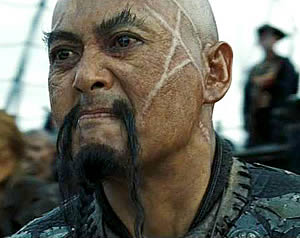
P.S. I was going to insert a picture of a really fat pirate for today, but it turns out that if you search for "fat pirate" you mostly get pictures of Chow Yun Fat as a pirate.


P.P.S. Since it's Tolkien Week, you could try to dress like a hobbit or a balrog and see if you can convince them to give you something. But you better take an eyepatch just in case.

Tuesday, September 18, 2012

J.R.R. Tolkien, C.S. Lewis and my childhood, and how they conspired to help me write The Sword of Six Worlds

When I was seven years old, our family went to a friend's house for dinner. Sometime along the way I must have complained of being bored or been harassing the adults, because someone pushed a strange looking book in my hand and said, "Go read this in the other room."


I started reading that night, and I remember thinking that this, too, was boring, as a fat little creature called a hobbit lived life in a town full of fat little creatures. Things didn't perk up much when the wizard or the dwarves arrived, as mostly there was singing (with lyrics) and discussions of food and then the fat little hobbit grumpily doing dishes. Then, suddenly, things started to happen in the book. Strange, wonderful, adventurous things unlike anything I'd read before in my life.

By the time we left for home, I begged to take the book with me. To my surprise, my dad said we had a copy already at our house. I was shocked. We had a copy of this strange and wonderful thing at our house already? Not only that, but my dad told me there were more books... that it was a series. I couldn't believe it.

Pretty soon I was reading books that looked like this, shoving them into my desk and destroying the covers:


These books were simultaneously more exciting than the Hobbit and full of far more boring asides. But I found I could skip the boring parts easily by turning the page if I saw a poem.

I hit the end of The Return of the King and couldn't believe that was it. I cornered my parents and said, "There has to be more. Are there other books like this?"

Lo and behold, my parents had SEVEN more books to show me, sitting on a shelf in our living room and this was the first one they unveiled:


These were written, it turns out, far closer to my reading level at the time, and not only that, but the main characters were human kids JUST LIKE ME (only British) instead of fat little hobbit creatures. I loved them, and I gladly read every book in the series without stopping for a break.

In the years that followed, I re-read those books a lot of times. In fact, when I left for college I took all my dad's copies of these books with me. When my kids were born I tried to introduce them to the stories too early. I told them a version of Lord of the Rings at bedtime when my oldest was four, and tried to read through the Narnia books with them soon afterward and they weren't all that interested.

I was, of course, disappointed, when my kids didn't "get it." I also tried to show them the Star Wars movies at which point my youngest started laughing that there was a "dog named Chewbacca" in the movie. Sigh.

I didn't give up, of course. Eventually, I started telling the kids a fantasy story of my own design, with a character "just like them" as the main character: a young girl who always tried to do the right thing, who had parents who loved her, who got invited somehow to save the world from evil by following strange guides into a fantasy world.

That became, in time, the story of Validus Smith, the paladin, the protector of six fantasy worlds. It's a sort of love letter from me to Tolkien and Lewis. It's not the same as their books, of course, but it comes from the same place: a child-like love of wonder, and of the world around us as well as the things that we never see but suspect must be there (whether that's elves or quarks or talking tigers). My hope is one day there will be kids who read the book, grow up, write their own books and say, This one time I was at our family friend's house, and I was bored, and he gave me this book with a cover that looked like this:


And I finished it and said, "There have to be more books like this." And my parents introduced me to Tolkien and Lewis and T.H. White and a hundred other wonderful authors.